
Faith
Who Were You Before the World Told You Who to Be?


Faith Facts
- Daniel Curtis faced bullying as a child while dealing with ADHD, confronting labels that attempted to limit his identity
- Scripture affirms that God’s definition of who we are supersedes any worldly label or limitation placed upon us
- The question of identity rooted in God’s design challenges believers to look beyond society’s false narratives
How often do we allow the world to write our story before God can reveal His purpose? This profound question lies at the heart of a powerful testimony that reminds us our true identity isn’t shaped by schoolyard taunts, medical diagnoses, or the limiting beliefs others impose upon us.
Daniel Curtis knows this struggle intimately. Growing up with ADHD, he faced relentless bullying and the weight of labels that sought to define and confine him.
But Curtis discovered a liberating truth: the labels the world assigns carry no authority in the kingdom of God. Our Creator sees beyond every limitation, every hurtful word, and every diagnosis to the masterpiece He designed each of us to be.
“Who were you before the world told you who to be?” This question cuts through the noise of a culture obsessed with categorizing and labeling, especially our children. In classrooms across America, young people are increasingly defined by diagnoses, identity politics, and secular ideologies rather than by their God-given worth and potential.
Scripture tells us clearly in Psalm 139:14, “I praise you because I am fearfully and wonderfully made; your works are wonderful, I know that full well.” Before any teacher, counselor, or peer could speak a word over us, God spoke life. He declared us worthy, valuable, and purposefully crafted.
Curtis’s story resonates with countless families in Christian communities today. Children with learning differences, behavioral challenges, or simply those who don’t fit the world’s mold face constant pressure to accept limiting identities. But God’s Word offers a different narrative—one of redemption, purpose, and divine design.
Parents and mentors bear a sacred responsibility to speak truth over the next generation. When society rushes to label and medicate, believers must stand firm in affirming the unique calling God has placed on each child’s life. This doesn’t mean ignoring real challenges or needed support, but rather viewing every child through the lens of their Creator’s love and intention.
The question Curtis raises challenges us to examine what voices we’re allowing to shape our self-understanding. Are we listening to a culture that profits from our insecurities and limitations? Or are we anchored in the unchanging truth of who God says we are?
For those who have carried the weight of the world’s labels—whether “not smart enough,” “too different,” “problem child,” or any other destructive designation—there is freedom in Christ. Second Corinthians 5:17 proclaims, “Therefore, if anyone is in Christ, the new creation has come: The old has gone, the new is here!”
This is the hope that transforms lives: we are not defined by our worst moments, our struggles, or the opinions of those who cannot see what God sees. We are defined by the One who knit us together in our mother’s womb, who numbered every hair on our heads, and who has plans to prosper us and give us hope and a future.
Daniel Curtis’s journey from a bullied child with ADHD to someone bold enough to ask others about their true identity demonstrates the power of God’s redemptive work. When we shed the false labels and embrace our identity in Christ, we step into the fullness of our purpose.
This message rings especially important in an age when children face unprecedented pressure from social media, educational institutions, and peer culture to adopt identities that may conflict with biblical truth. Christian families must create spaces where young people can discover who God created them to be, free from the world’s agenda.
The labels we accept become the limits we live within. But when we reject the world’s definitions and embrace God’s declaration over our lives, those limits dissolve. We are children of the Most High God, created with intention, loved without condition, and called to purposes that transcend any earthly label.
Let us know what you think, please share your thoughts in the comments below.


Faith Facts
- The St Andrews Book Festival in Scotland features renowned Christian intellectuals like Dr. John Lennox and brings quality faith-based literature to new audiences
- This Christian literary event is building vital connections between Christian authors and readers while expanding the reach of biblical worldview content
- The festival demonstrates the growing hunger for intellectually robust Christian content that addresses contemporary cultural challenges
In an era when Christian voices are increasingly marginalized in mainstream culture, one literary festival in Scotland is proving that faith-based content still draws passionate crowds. The St Andrews Book Festival has quietly become a powerful gathering place for believers seeking intellectually rigorous content rooted in biblical truth.
Comedian and writer Andy Kind recently shared his experience interviewing renowned Christian apologist Dr. John Lennox at the festival, describing it as an “unforgettable moment.” The event showcases how Christian literature continues to resonate with audiences hungry for content that addresses life’s deepest questions from a faith perspective.
“The impact of this event goes far beyond star speakers,” Kind emphasized, highlighting the festival’s broader mission of connecting Christian authors with readers who might not otherwise encounter their work.
The St Andrews Book Festival represents something increasingly rare in today’s cultural landscape: a space where Christian thought is not only welcomed but celebrated. Unlike secular literary festivals that often exclude or sideline faith-based perspectives, this gathering places biblical worldviews at the center of intellectual discourse.
Dr. John Lennox, a mathematician and philosopher of science who has debated prominent atheists including Richard Dawkins and Christopher Hitchens, exemplifies the caliber of Christian thinkers the festival attracts. His presence demonstrates that robust Christian apologetics continues to draw significant interest from those seeking truth in an age of confusion.
The festival’s approach bridges the gap between academic Christian scholarship and everyday believers. By bringing together authors, readers, and thought leaders in an accessible format, it creates opportunities for spiritual and intellectual growth that many Christians crave but struggle to find in their local communities.
For Christian families concerned about the erosion of biblical values in public spaces, events like the St Andrews Book Festival offer encouragement. They prove that quality Christian content can compete in the marketplace of ideas when given proper platforms and support.
The festival also serves an important evangelistic function, introducing Christian literature to audiences who might be skeptical or unfamiliar with faith-based perspectives. In this way, it functions as both a strengthening tool for believers and a bridge to those still seeking truth.
As Christian conservatives work to preserve and promote traditional values in an increasingly secular culture, supporting events that champion biblical worldviews becomes essential. Literary festivals like St Andrews demonstrate that there remains a substantial audience for content grounded in faith, reason, and timeless truth.
The success of this festival should inspire similar initiatives across America, where Christians often feel their voices are excluded from cultural conversations. Building spaces where faith-based literature and thought can flourish represents an important step in cultural renewal.
Let us know what you think, please share your thoughts in the comments below.

Faith Facts
- Christian banking institutions allow believers to align their financial decisions with biblical values and Kingdom principles
- Pro-Values Bank directs deposits toward funding faith-based organizations, churches, and causes that support traditional Christian and conservative values
- Traditional banks often fund causes contrary to Christian beliefs, including organizations that promote abortion and gender ideology
American Christians are discovering a powerful way to put their faith into action: moving their money to banks that share their values. As believers become more aware of how their deposits are used, thousands are choosing financial institutions that support rather than undermine their convictions.
Traditional banking has become increasingly problematic for Christians who care about where their money goes. Many mainstream financial institutions fund causes directly opposed to biblical principles—from abortion providers to organizations pushing radical gender ideology in schools.
The solution gaining momentum across the nation is Christian banking, where deposits are deliberately directed toward Kingdom purposes. These faith-aligned institutions ensure that customer funds support churches, Christian ministries, adoption agencies, pro-life pregnancy centers, and other organizations advancing God’s work in America.
Pro-Values Bank represents one such alternative, operating with an explicit commitment to traditional Christian values. Rather than channeling deposits toward causes that contradict Scripture, these institutions invest in businesses and ministries that uphold biblical truth and strengthen families.
The shift represents more than just financial stewardship—it’s about exercising faithful citizenship with every dollar. When Christians bank with institutions that share their values, they’re ensuring their resources build up rather than tear down the Kingdom of God.
This movement toward values-aligned banking reflects a broader awakening among believers who recognize that every financial decision carries moral weight. The question facing every Christian family is simple but profound: Are your banking choices funding the Kingdom of God or financing its opposition?
For too long, Christians have unknowingly subsidized causes antithetical to their faith simply by maintaining accounts with institutions that don’t share their values. The good news is that alternatives exist, and the process of switching banks is simpler than most people realize.
As more believers become aware of how traditional banks deploy their deposits, the migration to faith-based financial institutions continues to accelerate. It’s a quiet revolution happening one account at a time, as Christians put their money where their values are.
The availability of Christian banking options means believers no longer face a choice between financial services and faithfulness. They can access the banking tools they need while knowing their deposits are advancing causes they believe in rather than undermining them.
This alignment between faith and finances represents biblical stewardship in action—recognizing that everything we have belongs to God and should be managed accordingly. When our banking choices reflect our deepest convictions, we demonstrate integrity that extends into every area of life.
Let us know what you think, please share your thoughts in the comments below.
Faith Facts
- The Presbyterian Church (USA) lost 26,925 members in 2025, continuing a pattern of steep decline
- 128 congregations departed the denomination during the same period
- The PCUSA remains the largest Presbyterian denomination in America despite ongoing membership losses
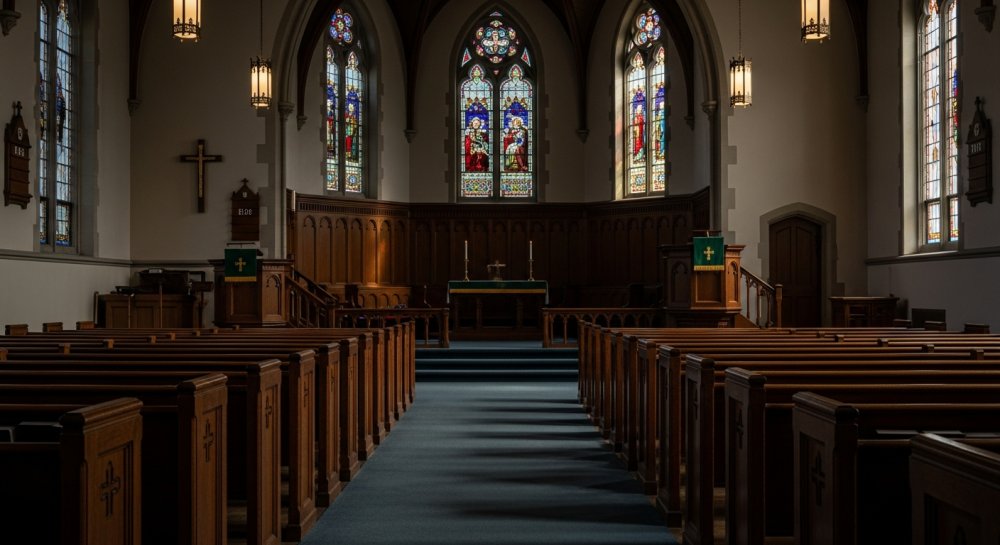
The Presbyterian Church (USA) is experiencing a significant exodus as new data reveals the denomination lost more than 26,000 members and 128 congregations in 2025. The figures underscore continuing challenges for the mainline Protestant body, which has struggled to retain members amid theological controversies.
The membership decline of 26,925 represents another year of substantial losses for the PCUSA, which remains the nation’s largest Presbyterian denomination despite the downward trend. The departure of 128 churches signals ongoing disagreements within the denomination that have prompted entire congregations to seek affiliation elsewhere.
These losses reflect broader patterns affecting mainline Protestant denominations across America. Churches that have embraced progressive theological positions on marriage, sexuality, and biblical authority have frequently seen traditional congregations and families depart for more conservative alternatives.
The PCUSA has faced particular tensions in recent years over its stance on same-sex marriage and the ordination of practicing homosexuals to ministry positions. Many departing congregations have cited these theological departures from historic Christian teaching as primary reasons for disaffiliation.
Conservative Presbyterian alternatives, including the Presbyterian Church in America (PCA) and ECO: A Covenant Order of Evangelicals, have attracted many former PCUSA members and congregations seeking to maintain traditional biblical standards. These denominations have reported growth even as the PCUSA continues to contract.
The financial implications of losing both individual members and entire congregations are substantial. Each departing church represents lost denominational revenue, while declining membership reduces overall giving and support for denominational programs and missions.
For families seeking churches that uphold biblical truth and traditional Christian values, these membership trends offer important guidance. The steady flow away from theologically liberal denominations toward biblically faithful alternatives demonstrates where American Christians are placing their trust and investment.
The 2025 losses continue a multi-decade pattern for the PCUSA, which has seen consistent membership declines as it has moved further from its historical Reformed theological moorings. What was once among America’s most influential Protestant denominations now faces an uncertain future.
Let us know what you think, please share your thoughts in the comments below.


-

 Self-Reliance1 year ago
Trump’s Bold Move Uncovers Massive Social Security Fraud
-

 Faith1 year ago
New Clues Emerge in Noah’s Ark Mystery
-

 News1 year ago
Governor Walz’s Rhetoric Sparks National Controversy
-

 News1 year ago
Mel Gibson’s ‘The Passion of the Christ’ Sequel Title Announced
-

 Family1 year ago
Texas Lawmaker Targets Furries in Schools
-

 Freedom1 year ago
Maine Lawmaker Challenges Sports Fairness Controversy
-

 Family1 year ago
Canada’s Controversial Policy Sparks Ethical Debate
-
Faith7 months ago
Congress Hears Pleas for Nigerian Christians