
Faith
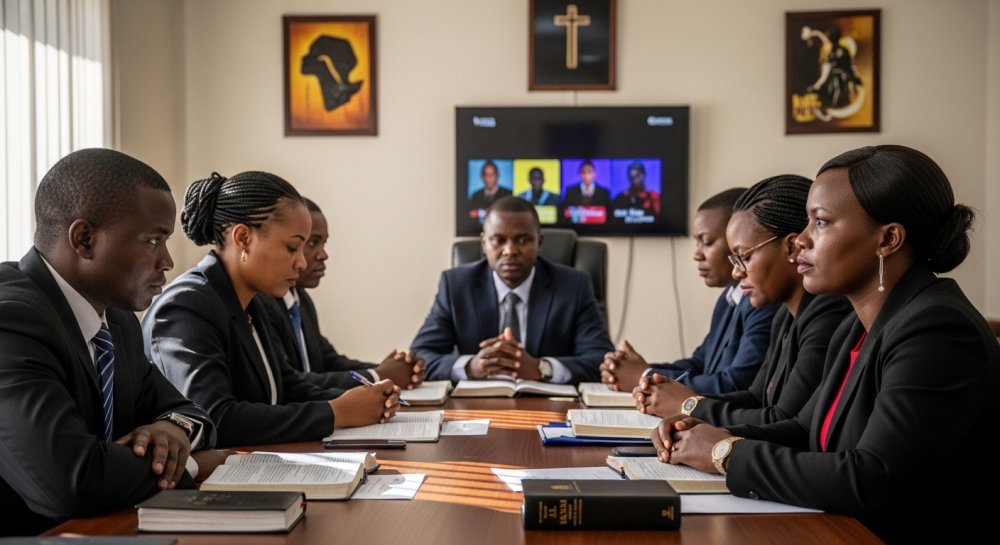
Zambian Church Leaders Sound Alarm on Media Content Threatening Children

Faith Facts
- The Evangelical Fellowship of Zambia is calling on media regulators to enforce stronger broadcasting standards to protect children from explicit content.
- Church leaders cite growing concerns about the harmful impact of unregulated entertainment programming on children and traditional family values.
- The appeal underscores a broader Christian movement in Africa to preserve moral standards in media and public life.
Christian leaders in Zambia are taking a stand against the tide of explicit content flooding the nation’s airwaves, warning that unregulated media is putting children and families at risk. The Evangelical Fellowship of Zambia has issued a strong call for media regulators to step up enforcement of broadcasting standards, citing the damaging effects of inappropriate entertainment programming on young minds and the erosion of traditional family values.
The fellowship’s appeal reflects a growing concern among faith communities across Africa that Western-style media content is undermining Christian morals and corrupting the next generation. As entertainment increasingly pushes boundaries with graphic imagery, sexual content, and anti-family messaging, church leaders are urging government authorities to take their responsibility seriously and protect the most vulnerable members of society.
This isn’t just about censorship—it’s about preserving the moral fabric of a nation. Christian parents in Zambia and around the world face an uphill battle in raising children according to biblical principles when popular media actively works against those values. The church’s call for stronger regulation recognizes that families cannot fight this battle alone; they need institutions to uphold community standards that reflect shared moral convictions.
The situation in Zambia mirrors challenges faced by Christian families everywhere. From streaming services to social media platforms, children today are exposed to content that would have been unthinkable just a generation ago. The normalization of violence, sexual immorality, and rebellion against authority in entertainment media has real consequences for how children develop and the choices they make as they grow.
The Evangelical Fellowship of Zambia’s stance demonstrates the vital role the church must play in speaking truth to power and advocating for policies that protect the innocent. While secular culture may celebrate the breakdown of traditional standards, Christian leaders understand that true freedom doesn’t mean license to corrupt—it means the ability to live according to God’s design without harmful interference.
African churches have often led the way in maintaining biblical orthodoxy while Western churches have compromised. This latest move by Zambian evangelicals shows that same courage and commitment to standing firm on principle. As media becomes increasingly globalized, local communities must retain the right to determine what kind of content is appropriate for their children and their culture.
The call for stronger media regulation also highlights the biblical principle that government has a God-given responsibility to protect citizens from harm. Romans 13 reminds us that authorities are established by God to punish wrongdoers and protect the innocent. When media companies profit from content that harms children and undermines families, regulators have a moral obligation to intervene.
Christian parents can learn from the Zambian church’s example by becoming more engaged in holding media companies and regulators accountable. This means not only monitoring what children watch but also advocating for policies that create a healthier media environment for all families. The fight for our children’s minds and souls requires both personal vigilance and collective action.
As the battle over cultural values continues to intensify worldwide, the church must remain vigilant and vocal. The Evangelical Fellowship of Zambia’s appeal serves as a reminder that protecting children and upholding biblical values sometimes requires direct confrontation with powerful interests that profit from moral decline.
Let us know what you think, please share your thoughts in the comments below.

Faith Facts
- SpaceX CEO Elon Musk has publicly warned that Europe faces an existential crisis due to mass unassimilated immigration.
- Musk rejected claims that concerns about immigration issues are inherently racist or far-right extremism.
- The tech entrepreneur’s statements come amid growing public debate over immigration policies and cultural integration across European nations.
SpaceX CEO Elon Musk has issued a serious warning about the future of Europe, cautioning that the continent faces a mounting crisis stemming from mass immigration without proper cultural assimilation. The tech entrepreneur and business leader spoke out against the prevailing narrative that frames immigration concerns as extremist positions.
Musk has been increasingly vocal about what he describes as a “serious and growing problem” facing European nations. His comments challenge the mainstream media and political establishment’s tendency to dismiss immigration concerns as “far-right” rhetoric.
ELON MUSK: Europe has a serious and growing problem.
“Europe has a serious and growing problem. I think you people are asleep at the switch and do not realize the magnitude of the issue. What you’re saying is total fiction. I’m simply saying that Europe needs secure borders and… pic.twitter.com/VzH9laXkrY
— DogeDesigner (@cb_doge) July 23, 2026
The Tesla and SpaceX CEO has pushed back firmly against accusations that raising these issues amounts to racism or extremism. His willingness to address these concerns publicly represents a significant voice in a debate that many in positions of influence have avoided for fear of being labeled intolerant.
For Christian conservatives and Americans who value national sovereignty and cultural preservation, Musk’s warnings resonate with longstanding concerns about the importance of assimilation and shared values in maintaining social cohesion. The principle that nations have the right and responsibility to control their borders and ensure newcomers embrace foundational cultural values has deep roots in both American tradition and Biblical teaching about the importance of unity and order.
Europe’s immigration challenges offer important lessons for the United States, where similar debates about border security, legal immigration reform, and the preservation of American identity continue to be contentious political issues. Many Christian conservatives see the European situation as a cautionary tale about what happens when nations prioritize global ideology over the wellbeing and cultural continuity of their own citizens.
Musk’s public statements on this issue demonstrate a willingness to speak truth even when facing potential backlash from progressive critics. His platform and influence give voice to concerns that millions of ordinary Europeans and Americans share but often feel pressured to suppress.
The ongoing debate over immigration policy across the Western world raises fundamental questions about national identity, cultural preservation, and the balance between compassion and wisdom in welcoming newcomers. For people of faith, these issues involve careful consideration of Biblical principles regarding hospitality, justice, order, and the proper role of government.
Let us know what you think, please share your thoughts in the comments below.
Faith Facts
- A UK-based ministry has launched training to help churches become more accessible for millions living with hearing loss
- The autumn initiative aims to equip congregations across the nation with practical tools to serve the hearing impaired
- The program reflects the Christian call to welcome and minister to all people, regardless of physical limitations
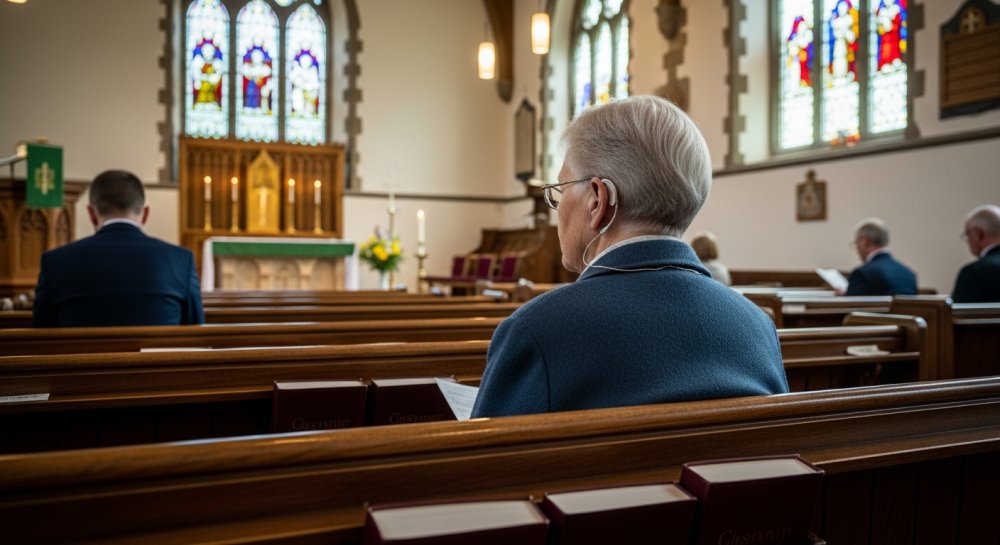
A British Christian organization is taking meaningful steps to ensure that churches across the United Kingdom can better serve congregants who struggle with hearing loss. The new training program represents a faithful response to the biblical mandate to care for those with disabilities and ensure all can fully participate in worship and fellowship.
The autumn initiative specifically targets the millions of British citizens living with hearing impairment, a population that has often faced barriers to full church participation. By equipping local congregations with practical accessibility tools and training, the ministry is helping churches fulfill their calling to be truly welcoming communities.
This effort speaks to a broader commitment within the Christian community to honor the dignity of every person created in God’s image. When churches invest in accessibility, they demonstrate that every member of the body of Christ matters and deserves full inclusion in the life of the congregation.
The training comes at a crucial time when many churches are seeking to rebuild and strengthen their communities following pandemic-related disruptions. By focusing on accessibility, congregations can ensure that their doors—and their hearts—remain open to all who seek to worship.
For believers, this initiative serves as a reminder that ministry is not complete until it reaches every person, including those who face physical challenges. The church’s mission has always been to break down barriers and create spaces where all can encounter the gospel and experience Christian community.
Let us know what you think, please share your thoughts in the comments below.
Faith Facts
- Two Oklahoma Churches of Christ, separated for nearly 60 years, reunited in 2020 to form a single congregation now approaching 500 members
- The merger occurred during COVID-19, with seven properties selling successfully and donated land leading to construction of a new 800-seat auditorium
- Members attribute the successful reunion to unified leadership, humble attitudes, and divine providence working through practical circumstances
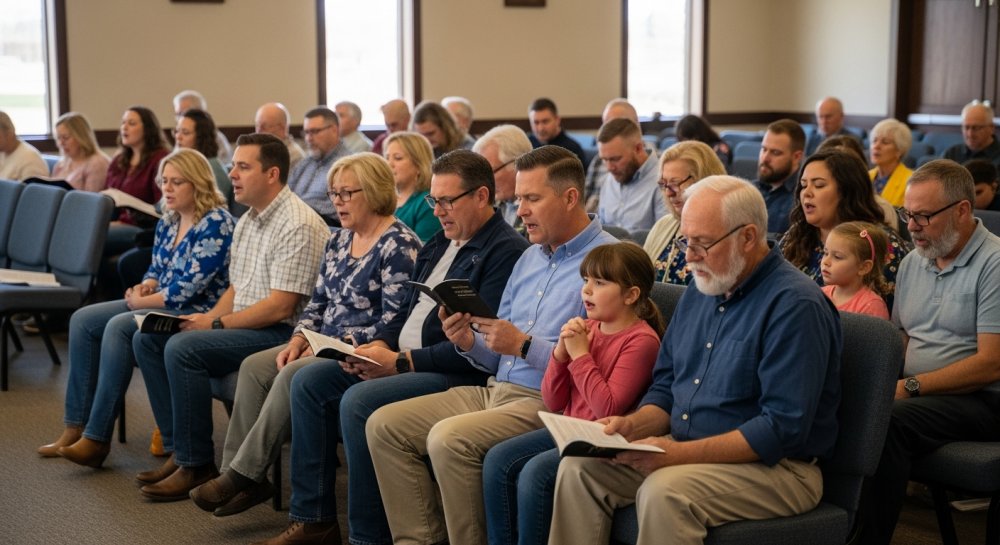
Just off U.S. 69/75 beside a Choctaw Travel Plaza billboard, nearly 500 Christians gather in a multipurpose room filled with four-legged cushioned chairs. “You are the melody. You are the harmony. Praise to your name I will bring,” the Durant Church of Christ sings as Sunday morning worship begins.
About 15 miles north of the Texas state line, this growing church in the home city of Southeastern Oklahoma State University is building a new, 800-seat auditorium. But while the construction proceeds, members will need to rearrange the chairs and set up tables for the monthly Friends & Family Day potluck meal following the assembly.
Not that they mind.
The faithful prefer to focus on the blessings of a multiyear journey that brought together two Durant congregations: the Seventh and Beech Church of Christ and the Northwest Church of Christ. “It’s been amazing,” Kim Mauck, 44, a mother of four, said of the 2020 merger just before the start of the COVID-19 pandemic.
“We love it for our family. Just the whole process has been positive for us.”
“I would say that for, like, maybe even the first year or two, you could kind of see people still sticking with their Northwest people and their Seventh and Beech people,” added Mauck. “But now it’s like, you can’t tell, and we’ve had so many new people who’ve come in, too. We’re all just one big group.”
Member Gail Hooten McKinney, 74, echoed Mauck:
“There’s never been a selfish attitude about it. It has been unified in, ‘What can we do to make this better for the community?’ And it’s been great.”
Frontier Roots
The combined church traces its roots to the Maddux and Roberts families, who passed through Indian Territory in 1894 while going from Arkansas to Texas in covered wagons. On the return trip to Arkansas, Cal Maddux, a gospel preacher, stopped and conducted a weeklong meeting.
Roughly 75 to 100 people gave their lives to Jesus in baptism, and the travelers decided to stay in Durant.
A few years before Oklahoma became the 46th state in 1907, a church split occurred over using an organ in worship. Those who objected to the instrumental music left the Christian Church and formed a Church of Christ.
After meeting in a smaller building, the Church of Christ erected a larger one at Seventh and Beech in 1917, said Jane Roberts Lewis, whose late grandmother was a niece of Cal Maddux.
“I grew up in the Seventh and Beech church,” said Lewis, 83, who interviewed her late aunt Jennie Maddux about the history in 1970.
“My dad was a deacon for 67 years, probably because he wouldn’t quit.”
By 1959, the Seventh and Beech congregation averaged Sunday attendance of 464, church records show. As the congregation outgrew its building, the elders announced plans to plant the Northwest church about a mile and a half away.
The new congregation met for the first time on July 1, 1962.
Northwest’s initial picture directory showed 88 adults and 20 children, while 379 members remained at Seventh and Beech, according to church records.
“At that point in time, with the town growing that direction, it made sense,” Layne Heitz, Durant’s pulpit minister and an elder, said of the church plant.
A Different Time
Americans’ driving habits were vastly different back then. Half-hour or hourlong commutes to eat, work — or worship — were not the norm.
“At one point in U.S. history, we saw more of the geographically specific, neighborhood churches,” said Mark Mulder, a sociology professor at Calvin University in Grand Rapids, Mich., who did a study on the subject.
“Today, with more sorting, worshipers are willing to drive past many churches to find the one that best fits their affinity.”
Some residents of Durant, a city of 22,000 that is the headquarters of the Choctaw Nation of Oklahoma, drive 95 miles south to work in Dallas. Against that backdrop, two like-minded congregations — separate and apart for nearly six decades — began to make less sense.
The Northwest church started with a sizable contingent of young professionals. But over the years, it became the older congregation in Durant — the one grandparents chose.
Seventh and Beech, meanwhile, maintained the Student Bible Center campus ministry and an active youth program. Younger families gravitated to it.
That’s how first cousins Jay Mauck and Matt Mauck ended up at different churches.
“You felt kind of torn on which church should I go to,” said Matt Mauck, 47, a fisheries biologist and father of three who moved to Durant in 2008.
“We found our place at Seventh and Beech, but we knew people at Northwest.”
Jay Mauck, 48, Kim’s husband and a former two-time All-American basketball player at Oklahoma Christian University, grew up at Northwest and stayed active in that congregation.
“When a young family would come over, we’d try really hard to keep them because we didn’t have many,” Jay Mauck said.
“And they’d go over to Seventh and Beech, and it was just covered with young kids and young families. … So there was a little bit of a divide.”
God’s Providence
When talk of a possible merger started, Seventh and Beech’s membership totaled about 300 — and Northwest’s was about 150. Heitz, who first came to Seventh and Beech as the campus minister 30 years ago and later taught math at Southeastern Oklahoma State, explained his support for the idea.
“One of the big motivating factors was the fact that there were 150 of my brothers and sisters that met across town that I did not know well,” he said.
“To be just a single, unified body of Christ here in Durant, there’s not even words that I can put on that to describe just what joy that brings to me.”
Even before the merger, the congregations would join together for Vacation Bible School and Christmas singing.
“When we were together, it just felt like family, you know?” Jay Mauck said.
Seventh and Beech’s three elders, including Heitz, approached Northwest’s three elders with a merger proposal in 2019. At first the Northwest leaders declined, but they later expressed an interest in considering the possibility.
Those discussions resulted in a joint decision to merge the elderships, the ministry staffs and the congregations in January 2020. Logan Cates, the combined church’s family minister, points to a series of providential developments — as he sees it — during that time.
“We were selling properties during the depths of COVID,” said Cates, who first joined the Seventh and Beech ministry staff in 2016.
“That’s the part that blows my mind. There were seven properties to sell, and they sold right in the middle of COVID.”
At the same time, a church member who had owned valuable property near Durant’s major four-lane highway for 30 years decided to donate much of it for the new building. Dollar General had tried to buy it but couldn’t get state approval for a median to allow vehicle access from both directions, said the owner, who asked not to be identified.
But after the member gave the land to the church, an elected official persuaded the state Transportation Department to permit the median. Why?
As Jay Mauck, the deacon overseeing the construction process, put it:
“God wanted this building to be here.”
Smoothing the Transition
In Heitz’s view, a choice by the combined church’s elders to make every decision unanimous has helped smooth the transition.
“If we don’t agree 100 percent,” he said, “then we will spend a week in prayer and come back together.”
One of those decisions: Making Sunday morning a worship-only experience. The church moved children’s and adult Bible classes to Sunday night.
“It’s difficult on families,” Heitz said of doing both in the morning. “We just said, ‘Why don’t we try this?’ We just did a trial for about three months, and the feedback we got from the congregation at large was like, ‘Our kids are doing better in worship service, and they’re paying more attention in Bible class in the evenings.'”
Sunday night attendance is up, too, compared with the previous format. Dean Marcho, 77, worships alongside generations of her family, including her mother, Bette Jo Mashburn, 100; her daughter Carrie Sullivan, 56; and her granddaughter Hannah Sullivan, 26.
Marcho’s late husband, Bob, was a minister, and they moved away from Durant for 45 years. But she still remembers attending Northwest’s first service at age 12.
Fifty-eight years later, she praised God in the newly named Durant church’s first assembly in 2020.
“It just felt like, ‘Lord, we hear you. This is what you want,'” she said.
“We were part of congregations that talked about merging, but it was never successful,” Marcho said. “Because the other congregation would come in saying, ‘Well, y’all move in here with us and leave your building and help us pay for ours,’ that kind of thing.”
“That was never a part of this discussion,” she said of the Durant merger.
“It was, ‘How can we glorify God?'”
Let us know what you think, please share your thoughts in the comments below.


-

 Self-Reliance1 year ago
Trump’s Bold Move Uncovers Massive Social Security Fraud
-

 Faith1 year ago
New Clues Emerge in Noah’s Ark Mystery
-

 News1 year ago
Governor Walz’s Rhetoric Sparks National Controversy
-

 News1 year ago
Mel Gibson’s ‘The Passion of the Christ’ Sequel Title Announced
-

 Family1 year ago
Texas Lawmaker Targets Furries in Schools
-

 Freedom1 year ago
Maine Lawmaker Challenges Sports Fairness Controversy
-

 Family1 year ago
Canada’s Controversial Policy Sparks Ethical Debate
-
Faith8 months ago
Congress Hears Pleas for Nigerian Christians