
Faith
This 150-Year-Old Christian Paper Still Reaches Britain’s Streets


Faith Facts
- The Salvation Army’s ‘War Cry’ newspaper has been published continuously since 1879, surviving nearly 150 years of cultural and technological change
- The publication began during Queen Victoria’s reign as a bold evangelical tool to reach the streets with the Gospel message
- Despite declining print media, ‘War Cry’ continues its mission on Britain’s high streets, demonstrating enduring faith and commitment to public witness
In an age when legacy newspapers are folding and digital media dominates, one Christian publication has refused to surrender. The ‘War Cry,’ launched by The Salvation Army in 1879, still appears on Britain’s streets nearly a century and a half after its founding.
The newspaper began during the reign of Queen Victoria, when Benjamin Disraeli served as her prime minister. At that time, Britain was at the height of its global influence, and The Salvation Army was just beginning its mission to bring the Gospel to the nation’s poorest and most forgotten.
The ‘War Cry’ became the movement’s bold voice—a weekly declaration of Christian truth carried into pubs, factories, and street corners. Its mission was simple: share the good news of Jesus Christ with those who might never darken a church door.
What makes this publication remarkable is not just its age, but its persistence. In a media landscape where even major secular outlets struggle to survive, ‘War Cry’ endures as a witness to the power of mission-driven journalism grounded in unchanging truth.
The newspaper represents more than nostalgia. It embodies a commitment to public Christian witness that refuses to retreat into comfortable church buildings. It stands as a reminder that the Gospel is meant for the marketplace, not just the sanctuary.
For Christian conservatives in America, the story of ‘War Cry’ offers encouragement. It demonstrates that faithful witness, sustained over generations, can outlast cultural trends and technological disruption. The mission remains: bring Christ to the people where they are.
The Salvation Army’s decision to maintain this street-level evangelistic tool reflects a theology of presence—being among the people, not separate from them. This approach resonates with the biblical model of incarnational ministry, where Christ himself walked among tax collectors and sinners.
As American Christians face increasing cultural pressure to privatize faith, ‘War Cry’ stands as evidence that public Christian witness can endure. The publication’s survival through two world wars, economic depressions, and dramatic social change proves that gospel-centered mission transcends temporary challenges.
The high street presence of ‘War Cry’ also challenges modern assumptions about effective evangelism. While digital strategies dominate contemporary church growth discussions, this newspaper demonstrates the continuing value of personal, face-to-face gospel proclamation.
Britain’s spiritual landscape has changed dramatically since 1879, with church attendance declining and secularism rising. Yet ‘War Cry’ continues its work, a tangible reminder that God’s truth doesn’t change with the times. The message proclaimed in Victorian England remains as urgent and relevant today.
For those who value traditional evangelism and public Christian witness, ‘War Cry’ represents hope. It proves that faithfulness matters more than popularity, and that mission sustained by conviction can outlast cultural opposition.
Let us know what you think, please share your thoughts in the comments below.

Faith Facts
- Over 200 young Christians gathered in Sussex, England to discuss Israel and Middle East theology in a respectful, unified setting
- The event brought together Christians from opposing viewpoints on Israel to engage in biblical dialogue rather than political debate
- Organizer Chip Kendall believes the gathering demonstrates how faith-centered conversation can bridge deep divides in the Church
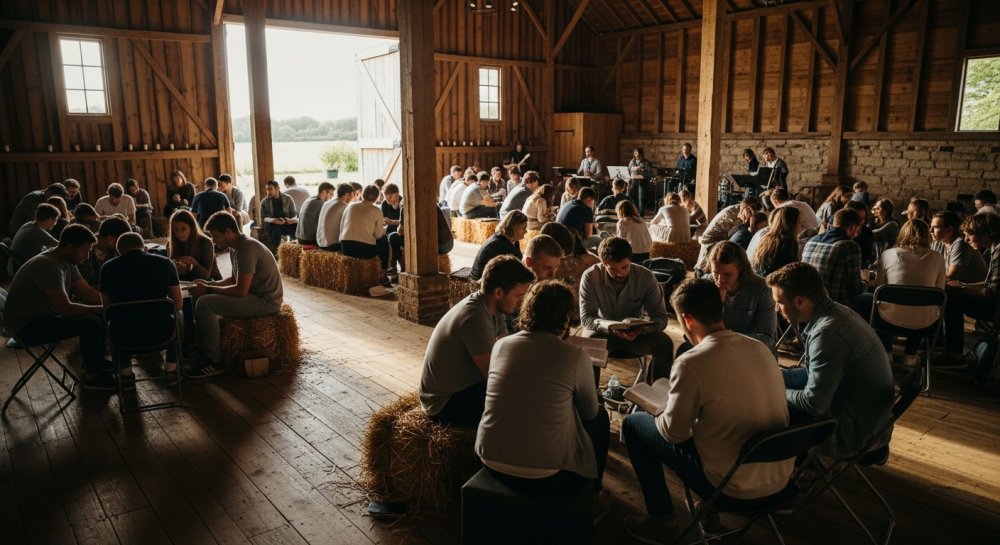
More than 200 young Christians recently traveled to the south coast of the United Kingdom for an extraordinary gathering that tackled one of the most divisive issues facing the modern Church. In a humble Sussex barn, believers from across the theological spectrum came together to discuss Israel, the Middle East, and what Scripture truly teaches about God’s promises to His chosen people.
The weekend event, organized by Chip Kendall and his team, sought to do something increasingly rare in today’s polarized religious landscape: bring Christians with fundamentally different views into the same room for honest, grace-filled dialogue. The topic of Israel has long divided evangelical and mainline Protestant communities, with disagreements over biblical prophecy, modern geopolitics, and the nature of God’s covenant with Abraham creating rifts that sometimes seem impossible to heal.
What made this gathering remarkable wasn’t that everyone agreed by the end. They didn’t. What made it beautiful was that they didn’t have to.
“We wanted to create space where young believers could ask hard questions without being shouted down or dismissed,” Kendall explained about the vision behind the event.
The Sussex gathering included worship, teaching sessions, small group discussions, and extended times of prayer. Attendees represented various denominational backgrounds and held views ranging from Christian Zionism to replacement theology, with many falling somewhere in between. Rather than staging a debate with winners and losers, organizers structured the weekend around Scripture study, historical context, and prayerful consideration of what it means to love both Jewish people and Palestinian Christians.
For many young Christians today, the question of Israel feels impossibly complex. They see images from Gaza and the West Bank that break their hearts. They also know the history of Jewish persecution and the miracle of Israel’s modern restoration. They read Romans 11 and wonder what Paul meant when he said “all Israel will be saved.” They hear their parents’ generation speak with certainty on both sides and wonder if there’s room for nuance, questions, and humble uncertainty.
The Sussex barn became that room.
“I came expecting to defend my position,” one attendee shared afterward. “Instead, I found myself listening to brothers and sisters who love Jesus just as much as I do, and realizing that my understanding of God’s heart might be smaller than I thought.”
Kendall believes this type of gathering represents something desperately needed in the broader Church. As political divisions increasingly infiltrate congregations and Christian communities fracture along ideological lines, the Sussex event offered a different model: unity in Christ doesn’t require uniformity of opinion on every complex geopolitical issue. What it does require is charity, humility, and a commitment to seeking God’s truth together rather than retreating into our separate camps.
The weekend wasn’t without tension. Conversations sometimes grew heated. Tears were shed. But so were walls. Attendees who arrived suspicious of those who disagreed with them left with new friendships and deeper respect for perspectives they’d previously dismissed.
“We didn’t solve the Israeli-Palestinian conflict in a Sussex barn,” Kendall acknowledged with a smile. “But we did prove that Christians can disagree about Israel without demonizing each other. In 2025, that feels almost revolutionary.”
The gathering also emphasized something often lost in online debates about Israel: the human cost of conflict and the Church’s responsibility to minister to suffering people regardless of their nationality. Palestinian Christians and Messianic Jews both face unique challenges, and the weekend included testimonies from believers in both communities who are living faithfully in difficult circumstances.
For American Christians watching from across the Atlantic, the Sussex gathering offers an important reminder. Our political opinions about Middle Eastern policy matter far less than our commitment to biblical truth, Christian charity, and the unity of Christ’s body. We can hold strong convictions about Israel’s role in God’s plan without treating fellow believers as enemies when they interpret Scripture differently.
The young Christians who gathered in that Sussex barn demonstrated something their elders would do well to emulate: the courage to engage difficult questions, the humility to listen to opposing viewpoints, and the faith to trust that God’s truth is big enough to handle our honest seeking. In an age of soundbites, social media pile-ons, and tribal loyalty tests, they chose a better way.
As these 200 young believers returned to their homes, churches, and communities across the UK, they carried with them something precious: proof that Christian unity doesn’t require ideological conformity. It requires Christ. And in a world desperately in need of witnesses to a different kind of kingdom, that’s a testimony worth preserving.
The Sussex barn gathering may have been a small event in the grand scheme of things, but its ripple effects could prove significant. When young Christians learn to navigate disagreement with grace, to prioritize relationship over being right, and to seek God’s truth together rather than apart, they’re building the kind of Church that can actually change the world.
Let us know what you think, please share your thoughts in the comments below.

Faith Facts
- The Bible presents nations as part of God’s sovereign design, beginning with the division of humanity into distinct peoples at the Tower of Babel
- Scripture reveals God chose Israel as a particular nation to be a light to all other nations, demonstrating His plan works through national identities
- The Great Commission calls believers to disciple all nations, affirming the continued relevance of national distinctions in God’s redemptive plan
As America grapples with questions of national identity and the proper relationship between faith and country, a timely examination of what Scripture actually teaches about nations reveals profound truths. The debate over Christian nationalism has created confusion among believers, but returning to biblical foundations provides clarity on whether nations are merely human constructs or part of God’s sovereign design.
The biblical narrative demonstrates that nationhood is neither accidental nor contrary to God’s purposes. From the earliest pages of Scripture, we see the Almighty establishing distinct peoples with unique identities, languages, and territories. The division of humanity into nations at Babel was not simply divine judgment but also a deliberate structuring of human society that would persist throughout redemptive history.
In the Old Testament, God chose one particular nation—Israel—to be His special possession among all peoples. This choice did not negate other nations but rather established a pattern: God works through particular communities to accomplish His universal purposes. Israel was called to be a light to the nations, demonstrating that national identity serves as a vehicle for divine revelation rather than an obstacle to it.
The covenant with Abraham explicitly includes blessing for “all nations on earth,” showing that God’s plan always encompassed every people group. The prophets consistently spoke of a future when all nations would stream to Jerusalem to learn God’s ways. This vision affirms national distinctions while pointing toward their ultimate unity under God’s rule.
In the New Testament, Jesus commissioned His followers to “make disciples of all nations.” The Greek word “ethnē” refers to distinct peoples and cultures, not a homogenized global citizenry. At Pentecost, the Holy Spirit enabled the apostles to speak in multiple languages, celebrating rather than erasing diversity. The book of Revelation portrays the redeemed from “every nation, tribe, people and language” standing before God’s throne—their distinctions preserved even in eternity.
This biblical framework challenges both extreme nationalism that idolizes the state and globalist ideologies that dismiss national identity as illegitimate. Nations are part of God’s created order, accountable to Him and meant to serve His purposes. Patriots can love their country without making it an idol, recognizing that national loyalty exists within the broader context of God’s Kingdom.
For American Christians, this understanding has practical implications. Our nation was founded on principles drawn from Scripture and the Western Christian tradition. Defending our constitutional heritage, borders, sovereignty, and values is not contrary to Christian faith but consistent with the biblical view that nations have legitimate interests and identities worth preserving.
At the same time, biblical patriotism recognizes that no earthly nation—not even America—is the Kingdom of God. Our ultimate citizenship is heavenly, yet our temporal citizenship matters. We can work for our nation’s flourishing while acknowledging that God’s purposes transcend any single country.
The current attack on national sovereignty comes not from biblical Christianity but from secular ideologies that seek to dissolve the bonds of family, community, and nation. Scripture presents a different vision: particular peoples with distinct identities, each accountable to God, together reflecting His glory in diverse ways.
As believers navigate these contentious debates, returning to what the Bible actually teaches provides a foundation that neither idolizes nor dismisses national identity. Nations are part of God’s design, instruments through which His Kingdom advances until that day when every knee bows and every tongue confesses that Jesus Christ is Lord.
This biblical vision honors both the particular and the universal—loving our neighbors including our fellow citizens, while recognizing that God’s love extends to all peoples. It allows Christians to be faithful patriots without becoming nationalists who place country above God, and faithful believers without adopting a borderless cosmopolitanism foreign to Scripture.
Let us know what you think, please share your thoughts in the comments below.
Faith Facts
- 50 women reported being coerced into sexual encounters through a swingers website, revealing patterns of manipulation and control
- Church communities must address similar power imbalances that allow abusive behavior to continue unchecked within congregations
- Creating cultures of accountability and proper placement of shame on perpetrators rather than victims is essential to protecting the vulnerable
A recent investigation has brought to light troubling patterns of coercion and abuse that demand our attention as people of faith. The findings reveal how power imbalances and manipulation can create environments where vulnerable individuals suffer in silence.
Fifty women came forward to share experiences of being forced into sexual situations they did not consent to through an online platform. Their testimonies expose how abusers exploit positions of influence and trust to victimize others.
For the Christian community, this serves as a sobering reminder that similar dynamics can exist within church walls. Men who abuse power, manipulate Scripture, and exploit spiritual authority to harm others have no place in leadership or fellowship until genuine repentance and restoration occur.
The Church has historically struggled with properly addressing abuse, often placing shame on victims rather than perpetrators. This must change. Our commitment to truth and justice demands we create environments where the vulnerable are protected and wrongdoers are held accountable.
Scripture is clear about the responsibility of those in positions of authority. James 3:1 warns that teachers will be judged more strictly, and 1 Timothy 5:19-20 provides a framework for addressing accusations against elders with both fairness and firmness when sin is confirmed.
True biblical leadership reflects Christ’s servant heart, not domination or exploitation. When church communities fail to confront abusive dynamics, they betray the very gospel they proclaim—one that liberates the oppressed and brings justice to the wronged.
The answer is not to simply point fingers at secular culture while ignoring similar problems within our own communities. Instead, we must courageously examine our own structures, ensure accountability systems are in place, and commit to believing and supporting those who come forward with allegations of abuse.
This means training church leaders to recognize warning signs of abusive behavior, establishing clear policies for reporting and investigation, and ensuring that forgiveness does not bypass justice or enable continued harm. Repentance without consequences is not biblical repentance.
We must also address the theological misuse that often accompanies abuse in church settings—twisted interpretations of submission, authority, and forgiveness that trap victims and protect abusers. Sound doctrine, rightly applied, protects the flock rather than exposing them to wolves.
The broader culture’s moral confusion makes the Church’s witness all the more critical. We cannot offer a compelling alternative if we simply mirror the same power abuses in religious garb. Our communities must demonstrate what it looks like when truth, justice, and mercy are genuinely pursued.
Creating safe churches requires intentionality: background checks, multiple-leader accountability, transparency in finances and decision-making, and cultures where questions and concerns are welcomed rather than silenced. Protection of the vulnerable must take priority over protection of reputation.
As believers, we are called to be salt and light in a broken world. That calling includes confronting sin wherever it exists—especially within our own households of faith. Only when we do so with courage and consistency can we speak with moral authority to the culture around us.
Let us know what you think, please share your thoughts in the comments below.


-

 Self-Reliance1 year ago
Trump’s Bold Move Uncovers Massive Social Security Fraud
-

 Faith1 year ago
New Clues Emerge in Noah’s Ark Mystery
-

 News1 year ago
Governor Walz’s Rhetoric Sparks National Controversy
-

 News1 year ago
Mel Gibson’s ‘The Passion of the Christ’ Sequel Title Announced
-

 Family1 year ago
Texas Lawmaker Targets Furries in Schools
-

 Freedom1 year ago
Maine Lawmaker Challenges Sports Fairness Controversy
-

 Family1 year ago
Canada’s Controversial Policy Sparks Ethical Debate
-
Faith8 months ago
Congress Hears Pleas for Nigerian Christians