
Faith
Anglican Leader’s Private Prayer with New Pope Sparks Ecumenical Questions

Faith Facts
- Bishop of London Sarah Mullally met privately with Pope Leo XIV for prayer in Rome
- The meeting follows a long tradition of Anglican-Catholic dialogue that has historically centered on unity despite doctrinal differences
- Mullally referenced past ecumenical meetings between Anglican and Catholic leaders as precedent for the encounter
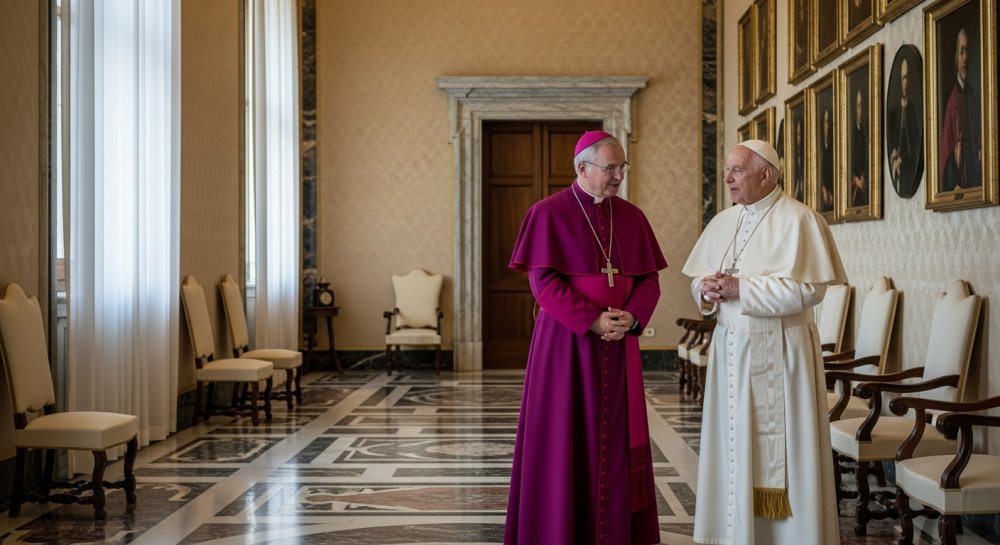
Bishop of London Sarah Mullally recently joined Pope Leo XIV for a private prayer session in Rome, marking another chapter in the ongoing relationship between Anglican and Catholic leadership. The meeting has drawn attention from Christians across denominational lines who are watching closely how these encounters shape interfaith dialogue.
Mullally, who serves as one of the Church of England’s most prominent bishops, pointed to previous ecumenical meetings between Anglican and Catholic heads as the foundation for her meeting with the newly installed pontiff. These historical encounters have often sought common ground on issues of faith while acknowledging significant theological divisions that remain between the two communions.
The Bishop of London’s decision to pray with Pope Leo XIV comes at a time when many Christian conservatives are evaluating the proper boundaries of ecumenical engagement. While unity among believers is a biblical principle, questions persist about how far cooperation should extend when fundamental doctrinal differences remain unresolved.
For traditional Anglicans and other Protestant believers, the meeting raises important considerations about the nature of Christian unity. The Reformation established clear distinctions on matters of salvation, scripture authority, and church governance that continue to define denominational boundaries today.
Past meetings between Anglican archbishops and Catholic popes have produced warm rhetoric but little substantive theological convergence on core issues such as papal authority, the role of tradition versus scripture, and the nature of salvation through faith alone. American Christians, particularly those in evangelical and conservative Reformed traditions, often view these ecumenical gestures with caution, emphasizing that true unity must be grounded in biblical truth rather than institutional diplomacy.
The appointment of Pope Leo XIV has generated interest across the Christian world, and leaders from various traditions have sought to establish relationships with the new pontiff. Mullally’s meeting represents the Anglican Communion’s early outreach to the new papal administration.
As ecumenical discussions continue, many believers are calling for clarity about what genuine Christian unity looks like in practice. While cooperation on moral and cultural issues may be appropriate, doctrinal compromise remains a concern for those who hold to the sufficiency of Scripture and the historic Protestant understanding of the Gospel.
The meeting between Mullally and Pope Leo XIV demonstrates the ongoing complexity of Christian relationships in an increasingly secular world, where believers face pressure to present a unified front even as they maintain distinct theological convictions.
Let us know what you think, please share your thoughts in the comments below.


Faith Facts
- God’s design for human sexuality is rooted in marriage between one man and one woman.
- Scripture teaches that our bodies are temples of the Holy Spirit and should be honored accordingly.
- Christian teaching holds that sexual expression outside of biblical marriage leads to spiritual harm.
New legislation targeting extreme violent pornography marks a step toward protecting families from harmful content.
James Mildred, a Christian commentator, welcomes the criminalization of violent pornographic material while calling for broader restrictions.
“New legislation will criminalise some of the most extreme forms of violent pornography.”
Mildred argues that partial restrictions fail to address the deeper moral concerns surrounding all pornography.
The Christian perspective emphasizes that pornography in any form contradicts God’s intended purpose for human sexuality.
“James Mildred welcomes the change, but argues that God’s design for sex means porn should be banned altogether.”
This position reflects traditional Christian teaching that sexual intimacy belongs exclusively within the covenant of marriage.
Let us know what you think, please share your thoughts in the comments below.
Faith Facts
- The Bible affirms the sanctity of human life from conception, grounding the pro-life position in Scripture.
- James Talarico’s claim that Scripture is silent on abortion overlooks multiple passages that protect the unborn.
- Christian teaching on life is rooted in the unchanging Word of God rather than shifting cultural arguments.
While the Bible does not use the modern term abortion, the absence of contemporary terminology does not mean the absence of biblical teaching. Scripture consistently affirms the value of life in the womb and condemns the shedding of innocent blood.
Old Testament law explicitly protects the unborn child, establishing a moral framework that transcends modern political debates.
Psalm 139 declares that God forms each person in the womb, knitting them together with purpose and intention.
“For you created my inmost being; you knit me together in my mother’s womb.”
This divine craftsmanship leaves no room for treating the unborn as disposable.
The prophetic witness in Jeremiah reinforces this truth, showing that God knows and calls individuals before birth.
“Before I formed you in the womb I knew you, before you were born I set you apart.”
Such language underscores the personhood and destiny of the child from the earliest moments of existence.
New Testament teaching on love and justice further strengthens the case for defending the defenseless.
Proverbs 24 warns against failing to rescue those being led away to death, a command that applies directly to the unborn.
Christian voters and lawmakers who uphold these biblical principles stand in continuity with generations of believers who treasured life as a gift from God.
Let us know what you think, please share your thoughts in the comments below.

Faith Facts
- Actress Danica McKellar credits Candace Cameron Bure with leading her to a personal relationship with Jesus Christ.
- McKellar is best known for her childhood role as Winnie Cooper on the beloved family series “The Wonder Years.”
- Bure, a committed believer, has consistently used her platform to point others toward faith and traditional values.
Danica McKellar opened up about the meaningful influence of her longtime friend Candace Cameron Bure in her journey toward faith. The two former child stars developed a friendship that extended far beyond their early careers in Hollywood.
McKellar explained that Bure was the one who introduced her to Jesus in a personal way. Their shared history in the entertainment industry gave McKellar a trusted voice to hear when spiritual matters came up.
“Wonder Years” actress Danica McKellar shares how fellow child star Candace Cameron Bure helped bring her to Jesus.
McKellar has spoken openly about her growing faith and the importance of surrounding herself with fellow believers. She has described how that friendship helped anchor her during seasons of change and uncertainty.
The story reflects a pattern seen among many in Hollywood who quietly seek truth and community outside the spotlight. For McKellar, that path led her straight to the feet of Jesus through the faithful witness of a friend.
Let us know what you think, please share your thoughts in the comments below.


-

 Self-Reliance2 years ago
Trump’s Bold Move Uncovers Massive Social Security Fraud
-

 Faith2 years ago
New Clues Emerge in Noah’s Ark Mystery
-

 News2 years ago
Governor Walz’s Rhetoric Sparks National Controversy
-

 News2 years ago
Mel Gibson’s ‘The Passion of the Christ’ Sequel Title Announced
-

 Family2 years ago
Texas Lawmaker Targets Furries in Schools
-

 Freedom2 years ago
Maine Lawmaker Challenges Sports Fairness Controversy
-

 Family1 year ago
Canada’s Controversial Policy Sparks Ethical Debate
-
Faith11 months ago
Congress Hears Pleas for Nigerian Christians