
Faith
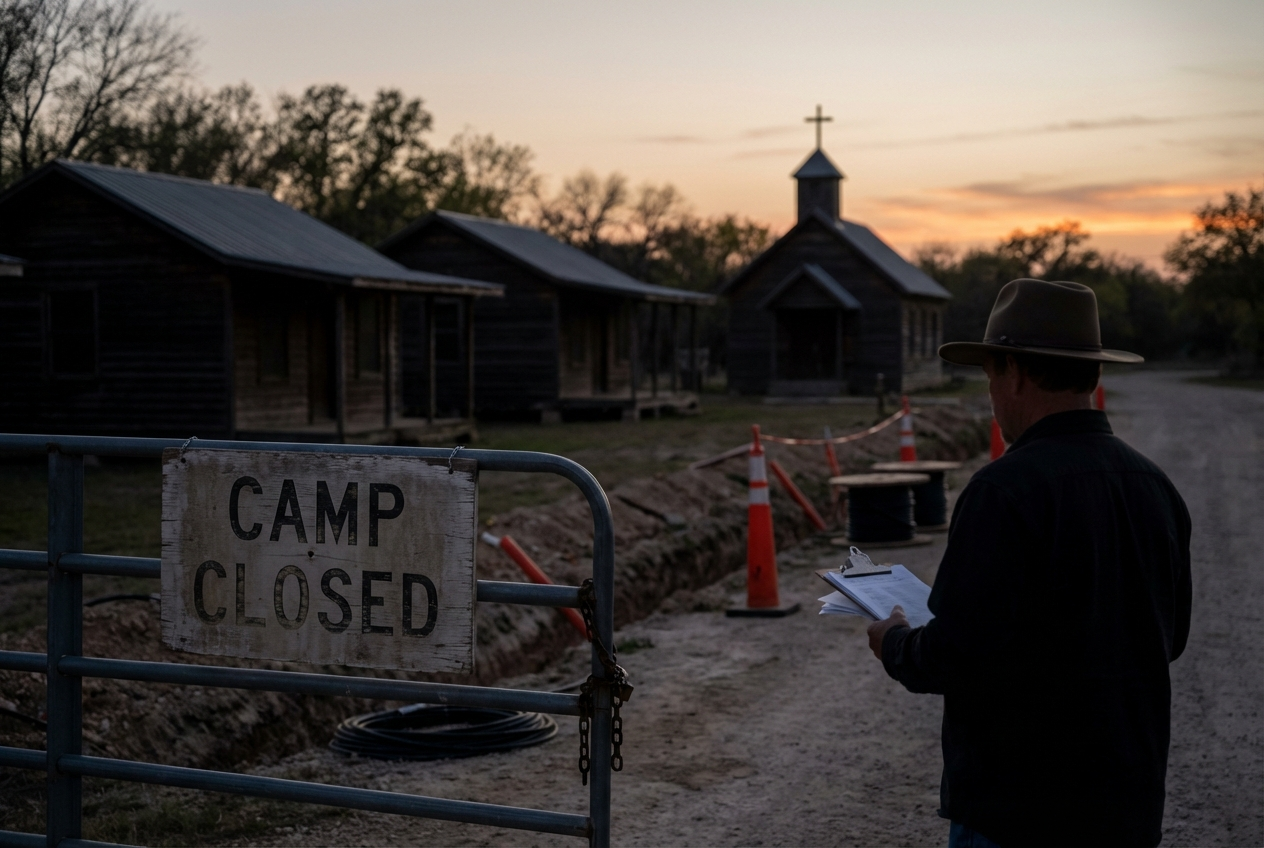
Challenges to Religious Freedom Rise as Faithful Camps Face Closure

Faith Facts
- Over 170 Texas camps currently lack the required fiber-optic infrastructure mandated by the new state laws.
- Licensing fees for some Christian camps have skyrocketed from $600 to $10,000, straining limited ministry budgets.
- Nineteen camps have filed a lawsuit challenging the constitutionality of these redundant and expensive requirements.
New state regulations in Texas are forcing beloved Christian youth camps to shutter their gates permanently. While intended to address safety after tragic flooding, the mandates impose heavy financial burdens on small ministry operations.
These rules require redundant fiber-optic internet and massive fee increases regardless of a camp’s location or proximity to water. Many directors believe these bureaucratic hurdles hinder the vital work of spreading the Gospel to the next generation.
“For camps that feel the charge to spread the seeds of the Gospel, it’s devastating.”
Despite these earthly challenges, faithful leaders continue to trust in God’s providence for the families and children they serve. We must pray for the preservation of these sacred spaces where young souls encounter the Creator through nature and fellowship.



Faith Facts
- Foreign aid budgets are increasingly being used to promote contested Western ideologies rather than genuine humanitarian relief
- Biblical stewardship calls for careful examination of how taxpayer dollars are spent in the name of charity
- True Christian compassion requires accountability and alignment with traditional values, not blind support of government programs
Supporting those in need across the globe has long been understood as a cornerstone of Christian duty. Yet when foreign aid becomes a vehicle for imposing controversial Western social agendas on developing nations, believers must ask whether such spending truly reflects biblical compassion or something far different.
Lois McLatchie Miller raises an important question that challenges conventional assumptions about foreign aid. The issue extends beyond simple generosity to matters of stewardship, accountability, and the proper role of government in expressing charitable values.
When aid dollars are tied to the adoption of progressive social policies that conflict with the traditional values of recipient nations, the moral calculus changes dramatically. What appears as charity on the surface may function as ideological coercion beneath, pressuring vulnerable countries to embrace secular Western worldviews in exchange for desperately needed resources.
Christian conservatives have long championed genuine humanitarian assistance that respects the dignity and sovereignty of receiving nations. Scripture calls believers to care for the poor and vulnerable, but it also demands wisdom and discernment in how that care is administered.
The concern is not with helping those in genuine need, but with the strings attached to modern aid packages. When governments condition assistance on the acceptance of gender ideology, abortion access, or other policies that contradict biblical teaching, they transform charity into cultural imperialism.
Accountability matters in every area of stewardship, especially when it involves the hard-earned tax dollars of American families. Christians have a responsibility to ensure their resources—whether given voluntarily or collected through taxation—are used in ways that align with their values and truly serve those in need.
True compassion requires both generosity and wisdom. It means examining not just the intention behind aid programs, but their actual implementation and effects on the ground.
The debate over foreign aid priorities reflects a broader tension between genuine Christian charity and the modern progressive project. While both may use the language of compassion, their underlying worldviews and ultimate goals often diverge significantly.
As Americans face difficult budget decisions at home, the question of how foreign aid is allocated and conditioned deserves serious scrutiny. Supporting our brothers and sisters overseas remains important, but not at the expense of imposing ideologies that undermine the very values we claim to uphold.
Let us know what you think, please share your thoughts in the comments below.
Faith Facts
- The Church of England has voted to engage with a controversial Palestinian Christian document known as Kairos Palestine II
- Palestinian Christian Jack Nassar urges the church to listen to the lived experiences of his community in the Holy Land
- The document addresses the ongoing struggles and perspectives of Christians living in Palestinian territories
A Palestinian Christian is calling on the global Church to pay closer attention to the voices and experiences of believers living in the Holy Land. Jack Nassar welcomed the Church of England’s recent decision to engage with a document that has sparked both support and controversy among Western Christians.
The document, known as Kairos Palestine II, represents the testimony and concerns of Palestinian Christians regarding their daily reality. While its contents have divided opinion, Nassar argues that the fundamental issue goes beyond agreement or disagreement with specific positions.
“Whether you agree with it or not, the lived experience of Palestinian Christians deserves the dignity of being heard and believed,” Nassar said.
The Church of England’s vote to formally ‘hear’ the document marks a significant moment for Palestinian Christian advocacy. For many in the West, the very existence of a thriving Christian community in Palestinian territories comes as a surprise, despite Christianity’s roots in the region.
Palestinian Christians trace their heritage directly to the earliest days of the faith, maintaining an unbroken presence in Bethlehem, Jerusalem, and surrounding areas for two millennia. Today, however, this ancient community faces mounting pressures that threaten its continued existence in the land where Christ walked.
Nassar emphasized that hearing these voices doesn’t require Western Christians to abandon their own perspectives or political positions. Rather, it’s about extending Christian compassion and acknowledging the struggles of fellow believers who live under circumstances most Americans can scarcely imagine.
The Kairos Palestine documents—the first released in 2009 and the second more recently—emerged from Palestinian Christian leaders seeking to articulate their community’s challenges and calling for solidarity from the global Church. These documents have proven divisive, with some viewing them as necessary prophetic witness and others as politically problematic.
For Nassar and many Palestinian Christians, the core request remains simple: that their brothers and sisters in Christ would listen with open hearts to their testimony. They seek not necessarily agreement, but the basic Christian courtesy of being heard with respect and having their experiences acknowledged as valid.
The diminishing Christian population in the Middle East has become a concern for believers worldwide. In Palestinian territories, economic hardship, political instability, and lack of opportunity have driven many Christian families to emigrate, threatening the future of communities that have maintained the faith since apostolic times.
As Western churches grapple with how to respond to complex Middle Eastern realities, Palestinian Christians ask for what all believers should extend to one another: a willingness to listen, to pray, and to bear one another’s burdens as Scripture commands.
Let us know what you think, please share your thoughts in the comments below.

Faith Facts
- A Christian small group leader discovered the unexpected power of Scripture memorization when comforting a struggling brother in Christ
- What seemed like random Bible verses became exactly the words needed in a moment of crisis
- The experience transformed one believer’s view on the necessity of hiding God’s Word in our hearts
Derek Hughes never thought Scripture memorization was essential to his faith walk. Like many modern Christians, he relied on the accessibility of Bible apps and search engines when he needed God’s Word. But a powerful encounter in his small group would completely reshape his understanding of why believers have treasured memorized Scripture for millennia.
During a regular small group meeting, one of the men opened up about the heavy burdens crushing his spirit. As Derek listened with compassion, he searched his mind for the right words of encouragement, the perfect pastoral response that would bring comfort and hope.
Instead, what came to him were a couple of Bible verses he had memorized seemingly at random—passages he’d committed to memory for his own spiritual growth, not anticipating they would ever be needed for someone else. In the moment, Derek hesitated, wondering if these particular scriptures were even relevant to his friend’s specific struggles.
Then came the response that would change Derek’s perspective forever. The man looked at him with tears in his eyes and shared that those verses were exactly what he needed to hear—the precise words from God’s Word that spoke directly to his heart and circumstances.
This divine appointment illustrates a profound truth that our grandparents’ generation understood instinctively: there is irreplaceable value in storing God’s Word in our hearts through memorization. When the Holy Spirit needs to bring a specific scripture to mind—whether for our own encouragement or to minister to others—He can only remind us of what we’ve already learned.
The Psalmist declared this truth thousands of years ago: “I have hidden your word in my heart that I might not sin against you” (Psalm 119:11). Scripture memorization isn’t about legalism or showing off biblical knowledge. It’s about equipping ourselves to be used by God in moments when we don’t have time to pull out our phones and search for the right passage.
In our technology-dependent culture, we’ve outsourced memory to our devices. While Bible apps are wonderful tools, they cannot replace the supernatural work that happens when Scripture becomes part of our mental and spiritual framework. Memorized verses are available in hospital rooms at 3 AM, in conversations where pulling out a phone would be inappropriate, and in spiritual battles when we need God’s Word as our sword.
Derek’s experience reminds us that God prepares us in advance for the ministry opportunities He’s planning to bring our way. The verses Derek had memorized for his own benefit became exactly what another believer desperately needed to hear. This is how the body of Christ is meant to function—each member equipped with God’s truth, ready to speak life when the Spirit prompts.
For families raising children in an increasingly secular culture, Scripture memorization takes on even greater importance. When our kids face peer pressure, doubt, or spiritual attack, the verses they’ve hidden in their hearts will be their defense. No one can take away what’s been memorized, making it one of the most valuable spiritual inheritances we can give the next generation.
The traditional practice of Scripture memory isn’t outdated or unnecessary—it’s more vital than ever in a world that desperately needs the unchanging truth of God’s Word. Derek learned this lesson not in a seminary classroom, but in a living room where the Holy Spirit orchestrated a divine appointment that only memorized Scripture could fulfill.
Let us know what you think, please share your thoughts in the comments below.


-

 Self-Reliance1 year ago
Trump’s Bold Move Uncovers Massive Social Security Fraud
-

 Faith1 year ago
New Clues Emerge in Noah’s Ark Mystery
-

 News1 year ago
Governor Walz’s Rhetoric Sparks National Controversy
-

 News1 year ago
Mel Gibson’s ‘The Passion of the Christ’ Sequel Title Announced
-

 Family1 year ago
Texas Lawmaker Targets Furries in Schools
-

 Freedom1 year ago
Maine Lawmaker Challenges Sports Fairness Controversy
-

 Family1 year ago
Canada’s Controversial Policy Sparks Ethical Debate
-
Faith8 months ago
Congress Hears Pleas for Nigerian Christians